
Maison & Jardin Magazine
RENCONTRE AVEC BARBARA CHRISTOL, ARTISTE PLASTICIENNE
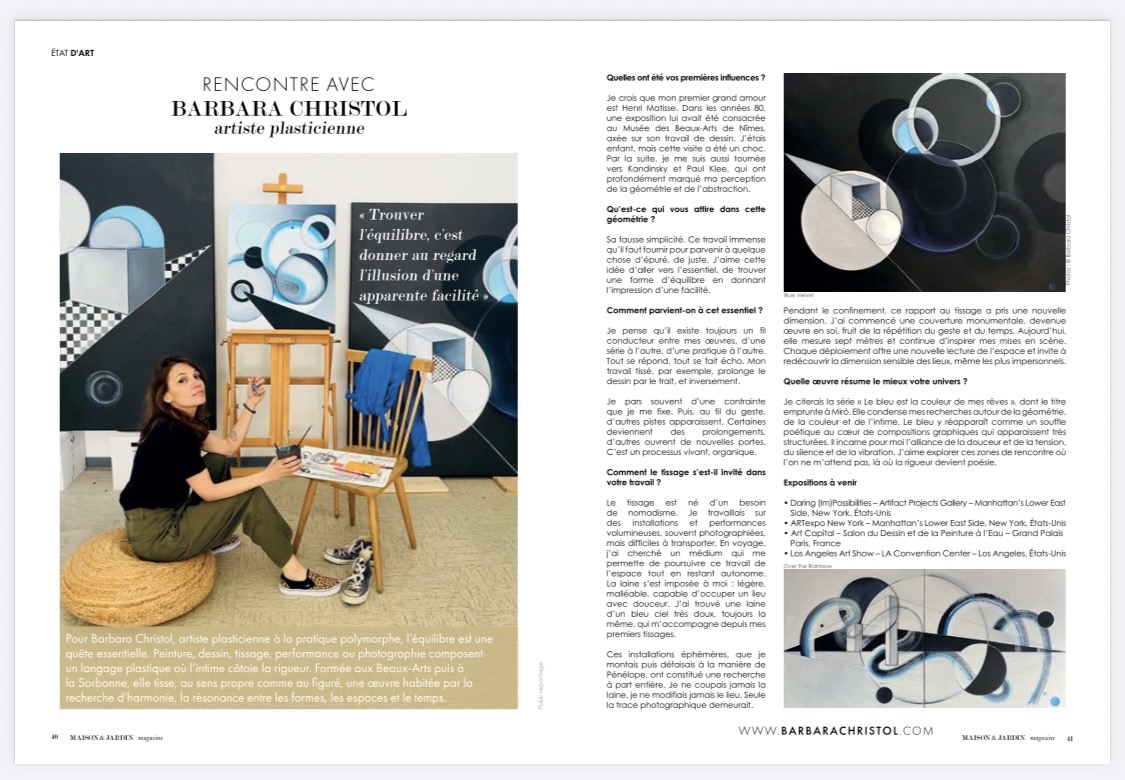
For Barbara Christol, a visual artist whose practice spans multiple disciplines, balance is an essential pursuit. Painting, drawing, weaving, performance, and photography come together to form a visual language in which intimacy meets precision. Trained at the Beaux-Arts and later at the Sorbonne, she weaves, both literally and figuratively. Her work is driven by a search for harmony and by the resonance between forms, spaces, and time.
WHAT WERE YOUR EARLIEST ARTISTIC INFLUENCES?
I think my first great love was Henri Matisse. In the 1980s, an exhibition devoted to his work was held at the Musée des Beaux-Arts de Nîmes, focusing specifically on his drawings. I was a child at the time, but the experience had a profound impact on me. Later, I also discovered Kandinsky and Paul Klee. Their work deeply shaped my perception of geometry and abstraction.
WHAT DRAWS YOU TO GEOMETRY?
Its deceptive simplicity. The immense amount of work required to arrive at something pared down and precise. I like this idea of moving toward the essential, of finding a form of balance while creating a sense of effortlessness.
HOW DO YOU ARRIVE AT THAT ESSENTIAL QUALITY?
I think there is always a common thread running through my work, from one series to another and from one practice to another. Everything responds to and echoes everything else. My woven work, for example, extends drawing through the line, and vice versa.
I often begin with a constraint that I set for myself. Then, as the gesture unfolds, other possibilities emerge. Some become extensions of the original work, while others open entirely new doors. It is a living, organic process.
HOW DID WEAVING FIND ITS WAY INTO YOUR PRACTICE?
Weaving emerged from a need for mobility. I was working on large-scale installations and performances, often documented through photography, but they were difficult to transport. While travelling, I began looking for a medium that would allow me to continue exploring space while remaining autonomous. Wool naturally became the answer: light, malleable, and able to inhabit a space with a certain softness. I found a very soft sky-blue wool, always the same one, which has remained with me since my earliest woven pieces.
Like Penelope, I would assemble and then unravel these ephemeral installations. In this way, they developed into a body of research in their own right within my artistic practice. I never cut the wool, nor did I alter the spaces themselves. Only the photographic trace remained.
Then, during lockdown, my relationship with weaving took on a new dimension. I began creating a monumental blanket that gradually became a work in its own right, born from the repetition of gesture and the passage of time. It now measures seven metres and continues to inspire the ways in which I stage and activate it. Each new deployment offers a different reading of space and invites us to rediscover the sensory dimension of a place, even the most impersonal one.
WHICH WORK BEST encapsulates YOUR ARTISTIC UNIVERSE?
I would choose the series Le bleu est la couleur de mes rêves (Blue Is the Color of My Dreams), whose title is borrowed from Miró. It brings together my explorations of geometry, colour, and intimacy.
Blue reappears as a poetic breath at the heart of graphic compositions that may initially appear highly structured. For me, it embodies the meeting of softness and tension, silence and vibration. I like to explore these unexpected points of encounter, where rigor becomes poetry.
UPCOMING EXHIBITIONS
The artist’s work can be seen in 2026 at:
Daring (Im)Possibilities – Artifact Projects Gallery – Manhattan’s Lower East Side, New York, USA
ARTexpo New York – Manhattan’s Lower East Side, New York, USA
Art Capital – Salon du Dessin et de la Peinture à l’Eau – Grand Palais – Paris, France
Los Angeles Art Show – LA Convention Center – Los Angeles, USA